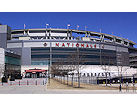
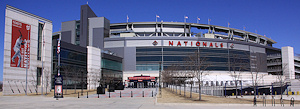
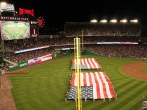
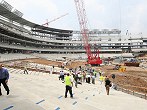
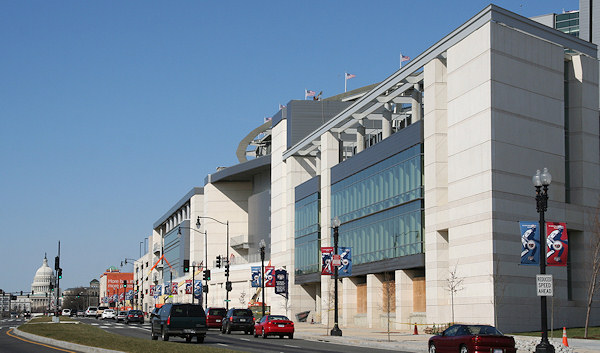
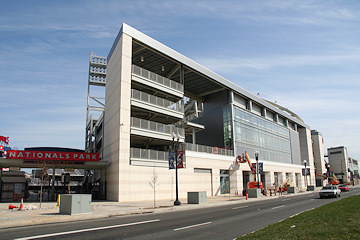
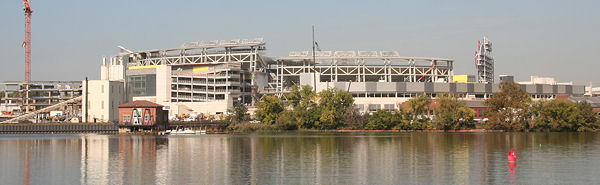
Southwestern facade of Nationals Park, at the intersection of Potomac Avenue and South Capitol Street. Nationals Park - New DC Baseball Stadium

In Dec. 2004, DC and MLB agreed to a public financing package to build a 41,888-seat baseball stadium, allowing the former Expos to move to DC. In Feb. 2006 the DC City Council capped the city's expenditures on the project at $611 million, though land acquisition and other costs eventually drove the price tag to $693 million. The stadium, dubbed Nationals Park until naming rights have been awarded, opened officially on March 30, 2008, when the Nationals beat the Atlanta Braves 3-2.

Links:
Information on Ballpark Transportation and Parking
Events: See All Photo Galleries | Opening Night | First Exhibition
Nov. 13 Turf Unveiled | Topping Out (July '07) | Groundbreaking (5/06)

Nationals Home Page | DC Sports and Entertainment Commission | DCBallpark.com
Stadium RFP | Lease Agreement | Eminent Domain Offers | Demolished Bldgs.
DC CFO's Baseball in DC Page | 2003 Study on Possible Stadium Locations
JD's Stadium News Items & Additional Links


      Stadium Photo Guide and FAQ      Exterior Before and Afters      Inside the Ballpark      Stadium News Items      

Nationals Park in Photos, 2006 - 2008


Exterior Photos, and
Streetscape Before & Afters


The Field and Concourses

Events and Milestones    (See More)

Opening Night, 3/30/08

First Nats Game, 3/29/08

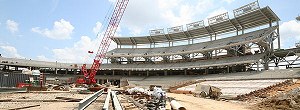
Topping Out, 7/11/07

Groundbreaking, 5/4/06

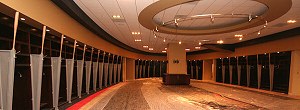
Restaurants, Clubs, Interior Areas

Construction Views (Inside), 2006-2007

Skyline Views
  
Demolished Buildings


JDLand's Nationals Ballpark FAQ

Updated 5/16/2009
These are general questions about the ballpark and its surroundings, answered to the best of my ability based on news media reports and my own research, keeping in mind that I do not work for the Nationals, or the city, or any other involved organization. (Who the heck am I, then? Read this.)

The Nationals now have posted a Ballpark A to Z Guide with answers to just about every question having to do with the operations of the ballpark that you could possibly think of.

Location and the Basics
1. Where is Nationals Park?
2. What does the ballpark look like? What was there before?
3. How much is the stadium costing? Who's paying for it?
4. I've heard it's a riverfront stadium. Is that true?
5. I've heard you can/can't see the Capitol Dome from within the ballpark. Is that true?

Access by Public Transit or Bicycle
6. What Metro stations are closest to the ballpark?
7. How many customers can the Navy Yard subway station handle?
8. Is the Navy Yard subway station west entrance finished?
9. What about Circulator or other bus access?
10. Will I be able to ride my bike to the ballpark?
11. Since the stadium is close to the river, will there be water taxi service?

Arriving by Car
12. Where am I going to park if I'm driving to the game?
13. How can there possibly be enough parking near the ballpark?
14. I bet the lots are going to be pricey. Should I just try to find on-street parking close by?
15. What about parking at RFK and taking a shuttle to the new ballpark?
16. What about parking at that huge new DOT HQ? How about at the Navy Yard?
17. Isn't traffic around there already a nightmare, even without any ballgames?
18. How is accessibility to the ballpark being handled for fans with disabilities?

Eating, Drinking, and Entertainment Options
19. Is there anywhere to eat/drink/recreate near the ballpark? (updated 1/20)
20. What food and beverage can fans bring into the ballpark?
21. What family entertainment options are there?

Games and Other Events
22. When was the first game at Nationals Park?
23. Will there be other non-baseball events at the stadium?

Nationals Park, By the Numbers

1. Where is Nationals Park?
Nationals Park is in the Southeast section of Washington DC, approximately one mile south of the U.S. Capitol; the site is bordered by South Capitol Street, First Street, N Street and Potomac Avenue. (Go to Google Maps for driving directions.)
Note that the stadium site is in Southeast DC, but is not in "Anacostia." The Anacostia neighborhood is on the east side of the Anacostia River--the stadium is on the west side of the Anacostia River.
The ballpark's western side faces South Capitol Street, with the
U.S. Capitol one mile to the north. (see more exterior photos)

2. What does the ballpark look like? What was there before?
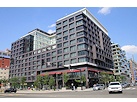
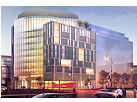
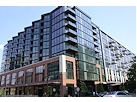
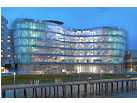
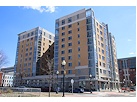
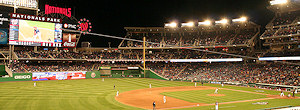
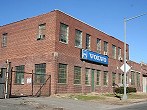
Nationals Park, with a capacity of approximately 41,000, has been designed to fit in with the limestone-and-glass look that has been used on many of the iconic buildings of Washington DC. (Though the ballpark's "limestone" is actually pre-cast concrete.) The ballpark's 21-acre footprint was home to warehouses, parking lots, asphalt plants, auto repair garages, five residences, and a strip of gay nightclubs, all of which were seized via eminent domain in 2005. You can browse my many photos of the ballpark's exterior and interior to see how it currently looks, and also see pictures of what the area looked like before construction began:
You can also see many of the renderings of the ballpark released over the past three years, as well as a gallery of the buildings that were demolished in Spring 2006 to make way for the stadium. And there's the Stadium Construction Web Cam, for up-to-the-minute views of the ballpark's interior.
3. How much is the stadium costing? Who's paying for it?
Nationals Park is a publicly funded stadium; Washington DC agreed to fully fund a stadium as part of the deal that brought the former Montreal Expos to Washington. The city council capped "hard expenditures" for the ballpark (including construction and land acquisition costs) at $611 million and so far the ballpark continues to be billed as "on budget", though lawsuits from the seizure of land for the ballpark via eminent domain have not all been settled. The city owns the ballpark, and it is operated by the DC Sports and Entertainment Commission. The ballpark has been paid for by the sale of $535 million in municipal bonds, which will be repaid by stadium-generated revenues and by a tax on businesses within the city. No money was taken from the city's general fund to pay for the stadium. Certain upgrades at the park that would break the cost cap are being paid for by the team's owners. For more on the deal between the city and the team, see the Feb. 2006 Project Lease Agreement.
4. I've heard it's a riverfront stadium. Is that true?
While the stadium is not right on the banks of the Anacostia River, it is only a short distance away. There will eventually be a public plaza across the street from the ballpark's southeastern entrance that ties the stadium to the riverfront. And the property immediately to the ballpark's south, which is now a somewhat unsightly concrete plant, is destined to become RiverFront on the Anacostia, a 5.8-acre mixed-use development with offices, residences, and retail. And the Anacostia Riverwalk Trail will eventually run along the riverfront for miles in each direction.


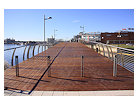
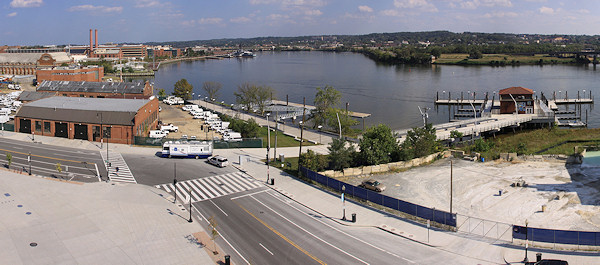
(Top) A view of Nationals Park from across the Anacostia River, at Poplar Point; (Middle) Looking to the east along the Anacostia River from the ballpark's southeastern viewing platform. The green area at center will eventually become Diamond Teague Park, a public plaza that will provide access to the riverfront. At lower right is part of the concrete plant that will become RiverFront on the Anacostia.
5. I've heard you can/can't see the Capitol Dome from within the ballpark. Is that true?

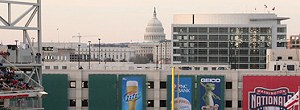
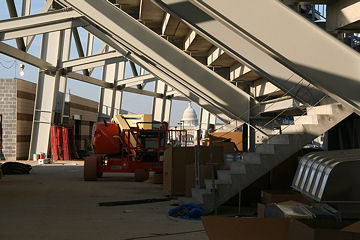
The U.S. Capitol dome as seen from inside the upper concourse along the third base line (left) and from the press box (right).
There are currently views of the Capitol dome from positions around the ballpark, though more along the first base line in the outfield and close to the press box. One completed building north of the ballpark--20 M Street, owned by the Lerners--blocks view the view of the Capitol for many seats near first base in the upper decks. The west parking garage and 20 M block the view of the dome for most seats in the lower bowl.

Even seats that have a view of the dome on Opening Day 2008 may lose it as development of the blocks north of the stadium continues. Monument Realty's Half Street project, which will bring the much-desired retail and restaurant offerings to the block just north of the ballpark, will eventually block views of the dome for most of the right-field seats.

Dome views from the third base line and from the northwest viewing platform will probably last a few years longer, as developments that would destroy that sight line are not imminent.


Early views of the dome from the right-field bleachers (seen here in March 2007) will be obscured by Opening Day by the Monument Half Street project (the hole in the ground at center right) and other developments north of the ballpark, as well as the outfield restaurant and eastern parking garage. 20 M Street is the silver building at center.


6. What Metro stations are closest to the ballpark?
The Navy Yard Metro station, on the Green line, is the closest to Nationals Park. The station's west entrance, at Half and M streets, SE, is one block north of the stadium. A second station entrance at New Jersey Avenue and M Street, SE, is approximately two blocks from the ballpark's northeast corner.

The Waterfront/SEU station, also on the Green line, is approximately 7/10th of a mile away from the ballpark, which is a 10- to 12-minute walk.

The Capitol South station, on the Orange and Blue lines, is approximately 8/10th of a mile away from the ballpark, which is about a 12- to 15-minute walk. (See more information on walking to the ballpark from Capitol South.)

The closest Red line station is Union Station, approximately 1.8 miles away. In February 2008, WMATA's board approved a plan to expand the service of its N22 bus that shuttles between the Union Station, Eastern Market, and Navy Yard subway stations, running the bus every 10 minutes on nights and weekends in addition to regular daytime service.

The closest Yellow line station is L'Enfant Plaza, where riders can connect to the Green Line for the trip to the Navy Yard station or to the Orange/Blue lines to go to Capitol South.

The Anacostia station, on the Green line, is approximately 9/10th of a mile away (though walking from there to the ballpark would require a trip by foot across the Douglass Bridge). It is one stop from the Navy Yard station and is the closest station with a parking garage. (See Metro's Daily Parking page for details on all its parking lots.)

In mid-January, Metro launched a Take Metro to Nationals Park page, with additional information on riding the subway to the ballpark, as well as bus lines and parking.


7. How many customers can the Navy Yard subway station handle?
A $20 million renovation project, completed in late March 2008, expanded the Navy Yard station west entrance's capacity, upgrading it from 5,000 customers an hour to 15,000 passengers an hour, the same number that the Stadium/Armory station next to RFK handles. Upgrades include increasing the number of fare gates and vending machines, adding two elevators, and relocating the station kiosk, fare gates and fare vendors from the mezzanine to the street entrance.

The station's renovation is being handled at the same time that a new office building (55 M Street) is being built on top of the station.

WMATA has also said it will be running additional trains on the Green line for games, as it used to do for games at RFK. Read this Metro press release for more details.

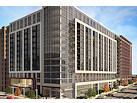
A rendering of what Navy Yard's west entrance will look like when 55 M Street is completed.

8. Is the Navy Yard subway station west entrance finished?
The station's west entrance re-opened for customer use on March 28, 2008.
9. What about Circulator or other bus access?
In March 2009, the city launched a new route for its special red Circulator buses, which run between Union Station (which has a Metro Red Line station), the new visitors' center at the U.S. Capitol, the Eastern Market Metro station on the Blue/Orange lines, and the ballpark.

Other Metrobuses that run close to Nationals Park include the 70, P1/P2, and V7/V8/V9.

See the Take Metro to Nationals Park page, with additional information on riding the subway to the ballpark, as well as bus lines and parking.

10. Will I be able to ride my bike to the ballpark?
Red bike racks have been placed in many locations around the exterior ballpark. There is also a "bike valet" service, where riders can drop off their bikes at the eastern parking garage at First and N streets for storage during the game.
11. Since the stadium is close to the river, will there be water taxi service?
The city is building a water taxi pier on the Anacostia River at Diamond Teague Park on the southeast corner of the ballpark. Various companies have expressed an interest in creating a service that could shuttle between locations like Alexandria, the new National Harbor, National Airport, the ballpark, the Southwest Waterfront, Georgetown. The city says the pier will be ready by July 2009. There are also plans for a water taxi pier at The Yards, two blocks to the east of the ballpark, but those piers aren't expected to be built before 2012.
12. Where am I going to park if I'm driving to the game?
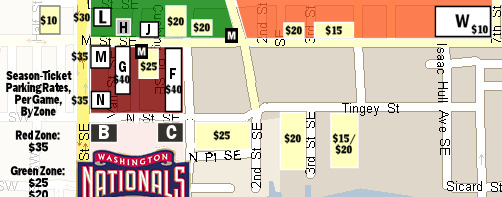
There are 1,325 spaces being built in three garages on the site of the ballpark, and the team cobbled together an additional 4,000-plus spaces in garages and temporary surface lots near the ballpark. See the Nationals WaytoGo page for more information on parking options.
13. How can there possibly be enough parking near the ballpark?
The neighborhood around the ballpark is very much in transition from an underused light-industrial area to a booming center of development. In time, nearly every block to the north and east of the ballpark will be home to a series of shiny tall buildings, each with hundreds of underground parking spaces. (There are five of these buildings already completed, with eight or more additional developments scheduled to be completed by the end of 2009. See my Development Map and Directory for details.) In the meantime, there are some temporary surface lots under construction that will help bridge the gap until these new buildings are completed. See the Nationals WaytoGo page for more information on parking options.
14. I bet the lots are going to be pricey. Should I just try to find on-street parking close by?
The Nationals and the city are going to be actively discouraging stadium-goers from trying to park on close-by streets. In January 2008 DC council member Tommy Wells introduced a bill to try a "performance parking" pilot plan around the ballpark area that would raise the cost of on-street parking signficantly during gametimes and would also prevent parking for longer than two hours. The city released a map of the streets affected by these new restrictions in late February, and the bill to set rates and fines in a two-year pilot program passed on March 4. Parking in metered spaces covered by these restrictions will cost $40 for four hours, to encourage drivers to use the lots rather than on-street parking.
15. What about parking at RFK and taking a shuttle to the new ballpark?
A deal has been or is about to be struck between the Nationals and the city to allow free parking in the huge surface lots at RFK stadium, with free shuttle buses running back and forth. See the Nationals WaytoGo page for more information on the Nats Express.
16. What about parking at that huge new DOT HQ? How about at the Navy Yard?
The city and the Nationals have reportedly been trying very hard to get access to the 800 spaces beneath the new US Department of Transportation headquarters one block from the ballpark. However, post-Sept. 11 concerns have made the Feds stand firm in their refusal to allow stadium parking at DOT HQ, even with ideas such as background checks or other stringent requirements. (Read a March 2008 Post column on the issue, and the DOT Office of Inspector General report.)

In March 2008, the Pentagram newspaper that serves the DC-area military community announced that "Washington Nationals fans who wish to attend evening and weekend home games may park their vehicles at the Washington Navy Yard or Fort McNair. A Department of Defense common access card, Retiree or Dependent ID card, and DoD vehicle decal are required for entry onto the installations for game parking." (Read the article for additional details and requirements.)

17. Isn't traffic around there already a nightmare, even without any ballgames?
Traffic was expected to be a huge problem with the opening of the ballpark, especially given the existing rush-hour delays, particularly at the South Capitol Street ramp from the Southeast Freeway. This is why the team and the city are emphasizing Metro and other alternate forms of transportation, in hopes of preventing total gridlock. However, a combination of dire warnings and smaller-than-expected crowds (and heavy use of Metro and other options) have resulted in little increased traffic on game days.
18. How is accessibility to the ballpark being handled for fans with disabilities?
A March 2008 Nationals press release says:
"Prior to every Nationals game at Nationals Park, the Metropolitan Police Department (MPD) will allow passengers to be dropped off along 1st Street, SE or along South Capitol Street; both locations are adjacent to Nationals Park, as near as possible to the two HOK designed accessible elevator entrances. After games, passengers may be picked up at the South Capitol Street location only. There are curb-free areas along South Capitol Street between O and P Streets." Season ticket holders with parking passes and state-issued disabled parking placards/license plates will be able to park in Lot E at First and N on a first-come first-served basis, or may purchase single-game access to those spaces for $35 per game. See nationals.com/waytogo for more information.

19. Is there anywhere to eat/drink/recreate near the ballpark? (updated 1/20)
As of this writing (May 2009), entertainment and nightlife offerings are limited around the ballpark.

The economic meltdown of 2008 has slowed considerably the vision for a "ballpark district" full of restaurants, shopping, and nightlife, and even the completed buildings are having a hard time finding retail tenants.

In May 2009, "the Bullpen" was launched on an empty lot just north of the ballpark's main entrance, offering food and beverages, entertainment, and other activities, opening two hours before each game and staying open until midnight.

And many other office and residential buildings are already underway or under development. See the map on my home page for all the details on projects underway and planned for the area near the ballpark. Expect to start hearing announcements of retail tenants in under-construction and completed buildings as Opening Day approaches.

But, if you're desperate to know what's there now, here's where you can get a bite to eat in Near Southeast as of May 2009:
Starbucks, New Jersey Avenue and M Street
Five Guys burgers, Second Street between L and M
Subway, Second Street between L and M
Sizzlin' Express, Fourth and M streets
Restaurant and Bar at the Courtyard by Marriott, New Jersey and L
Quizno's, Eighth and M streets
Al's Deli, Eighth and L streets
Port Cafe, Eighth and L streets

There are also a lot of restaurants outside Near Southeast but within a 20-minute or so walk to the ballpark:

Capitol South Metro: (400 block of First Street)
Bullfeathers
Tortilla Coast
Subway
Salay Thai

Eighth Street/Barracks Row:
(one block east of Eastern Market Metro)
Starbucks, 400 Eighth St., SE
Baskin Robbins/Dunkin Donuts, 801 Pennsylvania Ave., SE
Old Siam, 400 block Eighth St., SE
Popeye's, 400 block Eighth St., SE
Pizzaboli's, 400 block Eighth St., SE
Capitol Hill Tandoor and Grill, 419 Eighth St., SE
Cafe 8, 424-A Eighth St., SE
Subway, 400 block Eighth St., SE
Banana Cafe, 500 Eighth St., SE
Trattoria Alberto, 506 Eighth St., SE
Belga Cafe, 514 Eighth St., SE
Fusion Grill, 515 Eighth St., SE
Las Placitas, 517 Eighth St., SE
Cava, 527 Eighth St., SE
Jordan's 8, 500 block Eighth St., SE
Matchbox, 500 block
Starfish, 539 Eighth St., SE
Lola, 703 Eighth St., SE
Molly Malone's, 713 Eighth St., SE
Ugly Mug, 700 block Eighth St., SE
Today's Pizza, 700 block Eighth St., SE
Capitol Hill Subs, 751 Eighth St., SE


Pennsylvania Ave., SE:
Burrito Brothers, 205 Pennsylvania Ave., SE
Hunan Dynasty, 215 Pennsylvania Ave., SE
Sonoma, 223 Pennsylvania Ave., SE
Capitol Lounge, 229 Pennsylvania Ave., SE
Starbucks, 237 Pennsylvania Ave., SE
Cosi, 301 Pennsylvania Ave., SE
Good Stuff Eatery, 303 Pennsylvania Ave., SE
Taverna the Greek Islands, 305 Pennsylvania Ave., SE
La Lomita Dos, 308 Pennsylvania Ave., SE
Thai Roma, 313 Pennsylvania Ave., SE
Pennsylvania Ave. Pourhouse, 319 Pennsylvania Ave., SE
Tune Inn, 331 Pennsylvania Ave., SE
Hawk N Dove, 329 Pennsylvania Ave., SE

Eastern Market Metro:
Mr. Henry's, 601 Pennsylvania Ave., SE
Sizzlin' Express, 600 Pennsylvania Ave., SE
Aatish on the Hill, 609 Pennsylvania Ave., SE
Locanda, 633 Pennsylvania Ave., SE
18th Amendment, 613 Pennsylvania Ave., SE
Hunan King, 600 block of Pennsylvania
Quizno's, 660 Pennsylvania Ave., SE
Bread and Chocolate, 660 Pennsylvania Ave., SE
Prego, 210 7th Street, SE.
Tunnicliff's Tavern, 222 7th Street, SE.
Tortilla Cafe. 225 7th Street, SE.
Montmartre. 327 7th St., SE.

20. What food and beverage can fans bring into the ballpark?
From the Policies and Information statement that comes with ticket packages: "The following items are prohibited in Nationals Park: metal, plastic or glass containers of any kind except for factory-sealed, plastic water bottles, no larger than one liter, and juice boxes; only one (1) bottle of water will be permitted per person; all food items must be contained in single-serving bags within a soft-sided container or cooler that does not exceed 16"x16"x8"."
21. What family entertainment options are there?

A 15,000-square-foot family area called the Strike Zone is available in the ground floor of the eastern parking garage, accessed from inside the Center Field Gate of the ballpark. It will include a Sony Playstation Pavilion, a Build-a-Bear workshop (where childen can build bears (left), Screech toys, and Dugout Dog), a karaoke station, batting and pitching cages, and a jungle gym. There will be a concession stand with kids meals, a build-your-own peanut butter and jelly sandwich bar, and other food for kids (fruit salads, sliced apples, bottled water, juice boxes, and more). It will open three hours before each game and close at each game's conclusion.

22. When was the first game at Nationals Park?
The first baseball game at Nationals Park was between George Washington University and Saint Joseph's University on March 22, a game open only to GW students and not the general public.

The first Nationals game at Nationals Park was on Saturday, March 29, 2008, an exhibition game between the Nationals and the Baltimore Orioles.

The first "real" game was the season opener against the Atlanta Braves on Sunday, March 30, 2008.

23. Will there be other non-baseball events at the stadium?
The city is allowed to have up to eight non-Nationals events a year at the ballpark. Pope Benedict XVI offered mass at the ballpark on April 17, 2008, and a new citywide high school baseball title game is being played at Nationals Park each year at the end of May. The first music concert is the Billy Joel-Elton John concert in July 2009.


The stadium, by the numbers:

Regular Seating: Nationals Park has 41,888 seats. That number includes 22,000 in the lower bowl, 2,500 club seats and 12,100 upper level seats.

Premium Seating: Two club lounges offers 1,800 seats to fans in two indoor locations. The 500-seat Founders Club and the 1300-seat Diamond Club provide both bar and dining services.

Suites: A total of 78 suites offer 1,112 additional seats. The suites will include eight 16-seat Founders Suites on the main level, two 24-seat Owners Suites, 58 12-seat standard suites on two mid levels and ten 24-seat Party Suites on the mid level.

Other Accommodations: The "Red Porch Restaurant," a separate restaurant and bar overlooking the outfield, will include 10,000 square feet of space. A 6,000-square-foot conference center and a 10,000 square foot picnic area will be available for group sales patrons. There will be a 10,000-square-foot youth training area and a 2,000-square-foot arcade.


Concessions and Retail: A total of 28,000 square feet of concession stands will provide refreshments to fans during events. Retail and novelty outlets will offer merchandise from 7,700 square feet of space. There will be 183 concession "points of sale" and nearly 65,000-square-feet of restaurant space. And 41,222 cupholders.

Family Entertainment: A 15,000-square-foot family area called the Strike Zone will be available in the ground floor of the eastern parking garage. It will include a Sony Playstation Pavilion, a Build-a-Bear workshop, a karaoke station, batting and pitching cages, and more.

Comfort and Convenience Facilities: There will be a total of 1,100 restroom fixtures. ATM's and first aid stations. There will be between 33" and 42" of legroom between rows, compared to 26" inches at RFK. There are eight escalators and seven elevators (compared to 7 and 1 at RFK), and the main level concourse is 40 feet wide, compared to 19 feet at RFK.


Left field line: 336 feet (RFK: 335)
Left field power alley: 377 feet (RFK: 380)

Center: 402 feet (RFK: 410)

Right field power alley: 370 feet (RFK: 380)
Right field line: 335 feet (RFK: 335)


      Stadium Photo Guide and FAQ      Exterior Before and Afters      Inside the Ballpark      Stadium News Items      


Near Southeast DC Home Page
Top of Page | RSS Feed | Contact JD
Advertise on JDLand.com

© Copyright 2009 JD.
All photos © Copyright JD - See information on photo uses, licensing and purchasing.


More Near Southeast
Home Page
Contact JD
About This Site
Advertise on JDLand
E-Mail Updates
'09 State of the Hood
Upcoming Events


RSS and Other Web 2.0 Feed Options

Feedburner Subscribers
JDLand.com on Twitter
JDLand.com on Facebook